Cinematic Spaces Film Review: Metropolis
“Hollywood lives for
money and sex. It borrows or buys its art. It is the Germans who are the
perpetual adventurers in the cinema. They gave the camera its stripling
mobility, its restless imagination.” (Evelyn
Gerstein, 2009)
Metropolis (1927) is a German expressionist science fiction
film written by Fritz Lang and his wife Thea Von Harbou, the film was directed
by Lang himself. Metropolis is
perhaps one of the most influential films in science fiction and special effects
and the boundaries it pushed in film & set production. The film features a
range of set designs, from a huge gothic cathedral to a futuristic cityscape. Lang
quoted saying, “the film was born from my
first sight of the skyscrapers of New York in October 1924". Describing
his first impression and the influence the city had on him, Lang said "the buildings seemed to be a vertical
sail, scintillating and very light, a luxurious backdrop, suspended in the dark
sky to dazzle, distract and hypnotize”
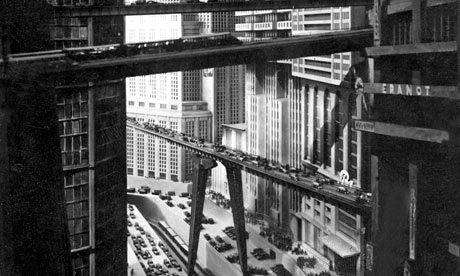
Fig 1 - The dark Cityscape
“Lang's impossibly
vast skyscraper-ziggurats (inspired, it's said, by his first view of the
Manhattan skyline) are the blueprint for nearly every science-fiction movie
city of the past 30 years.” (Ed Halter, 2007)
The Cityscape in Metropolis used the design and scale of the
buildings, to portray the power of industrialism. The buildings used throughout
the movie are very large, sometimes greatly exaggerated, often so much so that
they make the characters seem tiny and insignificant in and around the busy
city life. This helps to tie into the broken spirit portrayed throughout the earlier
scenes of the film, since the storyline has a dominant focus around the social
classes of society, with the workers forced to work long underpaid hours in the
lower parts of the city while the upper classes live high up in the
skyscrapers.
Fig 2 - The Portral of Emotion
The actors give the usual silent-film performance, full of over
exaggerated expressions and broad movements, but they express their characters humanity
in a way that is very relevant to the story. Cinematographer Karl Freund’s use
of a wide arrangement of stylized shadows, dramatic camera angles, and
geometric images all added to the movies style, and helped to really portray
the epic cityscape and characters throughout the movie.
Fig3 - The Awakening
“The meticulous
miniature photography and full-scale floods, explosions and riots, necessitated
a new level of collaborative ingenuity from every department” (Emanuel Levy, 2011)
Lang finished the film at a cost of 5.3 million, four times
as much as the film’s original budget of 1.5 million, this was due to his very
large sets and production style. The miniature sets were built on a grand scale
with key focus on perspective, wtith things like stop-frame animated vehicles moved
around the set from building to building. Over 36,000 extras were hired for the
live action flood, the worker rebellion, and the Tower scenes. This all added
to the huge cost of the film, but it obviously paid off big time as ‘Metropolis’ has gone on to influence many
science fiction film director, and set designers.
Bibliography
Images
Fig 2: https://blogger.googleusercontent.com/img/b/R29vZ2xl/AVvXsEj5RZhMKr4zAq2ZMPMqz7T0jpp8XO6dSac8OLgH6pFPcqtEa9bQ26SxBGfTEi8J-yO5osuO_E5ID4hYuB-jZLozTrnE4XAoyGAy3DmJW9_rulTvHM3yWlXaFipSHER-lcx-0b4wH2BceRc/s1600/Fritz+Lang+METROPOLIS+movie+image+%25282%2529500.jpg
Fig 3: http://picturesup.typepad.com/pictures-up/2012/03/index.html
Quotes